DEPARTMENTS
The college is organized into five major departments: (i) Old Testament; (ii) New Testament; (iii) Theology; (iv) Pastoral Ministry; and (v) Biblical Counselling. Other than these five departments, there are also specialised courses: (vi) Biblical Hebrew (under Old Testament); (vii) Biblical Greek (under New Testament); (viii) Church History (under Theology); and (ix) Christian Education (under Pastoral Ministry). The curriculum offered will fall under all these categories. [The Master of Ministry programme is a block-module programme which will be administered separately.]
CURRICULUM
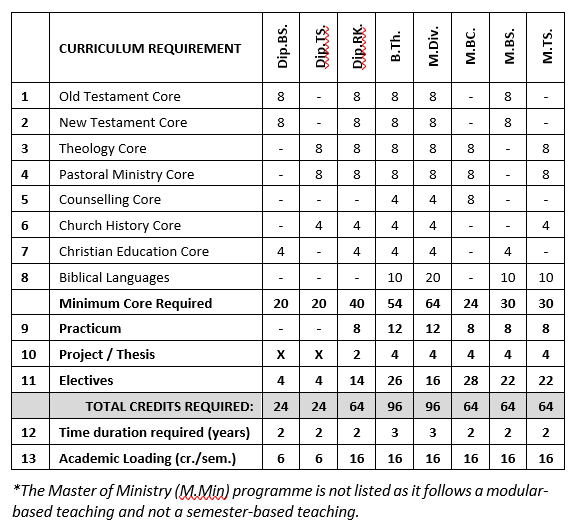
The curriculum for the academic programmes is designed to provide a balance of biblical / theological studies and pastoral / ministry training to equip the students. The curriculum comprises core subjects in Old Testament / New Testament studies, Christian Education, Church History, Theology, Pastoral Ministry and Counselling. The study of Biblical Languages is required for degree programmes. Students are expected to enrol for an average of 16 credits per semester in order to complete the requirement of the course within the specified time frame. Students who wish to enrol for more than 16 credits per semester must seek the approval of the Academic Dean. A minimum 12-credit per semester is required for all full-time students.
CORE MODULES
The Core Modules refers to the modules which comprise the essential part of the specific track offered by each department. Each department would offer 4 core modules, and 2 specialised core modules (other than Biblical Counselling which has no specialised core modules).
- Old Testament:
- Core Modules (8 credits): The Pentateuch (2 credits), The Historical Books (2 credits), The Poetic Books (2 credits) and The Prophetic Books (2 credits).
- Specialised Core Modules (10 credits): Basic Biblical Hebrew I & II (6 credits) and Analytical Biblical Hebrew I & II (4 credits).
- New Testament:
- Core Modules (8 credits): Introduction to New Testament (2 credits), Jesus & the Gospel (2 credits), Paul & His Writings (2 credits) and Apocalypse & the General Epistles (2 credits).
- Specialised Core Modules (10 credits): Basic Biblical Greek I & II (6 credits) and Analytical Biblical Greek I & II (4 credits).
- Theology:
- Core Modules (8 credits): Bibliology & Theology Proper (2 credits), Anthropology & Soteriology (2 credits), Christology & Pneumatology (2 credits) and Ecclesiology & Eschatology (2 credits).
- Specialised Core Modules (4 credits): Church History I: Post-Apostolic – Medieval (2 credits) and Church History II: Reformation – Modern (2 credits).
- Pastoral Ministry:
- Core Modules (8 credits): Homiletics (2 credits), Hermeneutics (2 credits), Apologetics (2 credits) and Pastoral Ethics (2 credits).
- Specialised Core Modules (4 credits): Introduction to Christian Education (2 credits) and The Principles & Methods of Teaching (2 credits).
- Biblical Counselling:
- Core Modules (8 credits): Introduction to Biblical Counselling (2 credits), The Theology of Biblical Counselling (2 credits), Counselling Issues (2 credits) and Marriage & Family Counselling (2 credits).
- Specialised Core Modules (8 credits): Dynamics of Biblical Changes (2 credits), Theories of Counselling (2 credits), Counselling in the Local Church (2 credits) and Biblical Counselling Practicum (2 credits).
ELECTIVE MODULES
Elective modules refer to those modules which are not part of the core curriculum required by the specific academic programme which the student has applied. These modules are meant to complement the core curriculum to ensure a broader and varied scope of learning beyond the basic requirement. The elective modules sign-up for each semester will be based on the remaining credits required after the fulfilment of the core curriculum.
PRACTICUM
Full-time students are required to be attached to a church / organization as an understudy to a supervisory pastor / full-time worker as assigned by the College for a specific semester. The practicum is designed to provide the student the exposure to ministering in different churches. This provides a more holistic approach to the ministry, with the students having a better understanding about ministering in a church.
THESIS
Bachelor / Masters students are required to submit a thesis in the final year of their programme. Unless approved by the College, the thesis advisor must be a faculty member of the College. The thesis spans over two semesters and must be completed before the student can graduate. The thesis ought to be in the field of the student’s training. The requirement for thesis is as follows:
Bachelor: 10,000 words (40 pages)
Master of Divinity: 20,000 words (80 pages)
Other Master programmes: 15,000 words (60 pages)
All Master students are required to do a presentation to the faculty on their thesis.
For the diploma programme, no thesis is required. However, the diploma student may be required to complete a final year project (2 credits) in their final semester.
ACADEMIC TRACKS
Each of the various academic programmes would require careful planning to enable the students to complete all the necessary requirements within the stipulated time duration. Students are expected to follow all the necessary requirements in their academic track of training. For part-time programmes, a minimum of 6 credits / semester is required. For full-time programme, students are expected to fulfil a minimum of 16 credits / semester. The overall requirement for each academic programme is as shown in the table below.