
The academic programmes offered in our college will follow the academic track assigned. Students are expected to sign up for the modules according to their academic loading to ensure that they would be able to complete their programmes within the stipulated time duration.
- CERTIFICATES OF RELIGIOUS KNOWLEDGE (Cert.BRK. / Cert.HRK.)
The basic certificate of religious knowledge is offered to lay-Christians in their desire to acquire knowledge of theology and the Bible. The admission requirement is five ‘O’-level passes or its equivalent. Students will be awarded a basic certificate of religious knowledge (Cert.BRK.) when they have completed 20 credits successfully. Upon completion of the basic certificate, they can proceed to do the higher certificate of religious knowledge (Cert.HRK.), which requires another 20 credits. For the certificate-level of training, the students can sign up modules of their interest and are not required to follow a specific academic track. However, the number of credits required must be fulfilled within a 5-year period. - SPECIALIST DIPLOMA IN BIBLICAL STUDIES (Dip.BS.)
Specialist Diploma in Biblical Studies (Dip.BS.) is a specialised branch of training for lay-leaders in the knowledge of the Bible. The admission requirement is two ‘A’-level passes or its equivalent. Students are required to fulfil the track of training in Biblical Studies (Old Testament and New Testament). Total credits required for this programme is 24 credits. Students are required to sign up 6 credits / semester in order to complete this programme within a 2-year period. The academic load for each semester is as follow: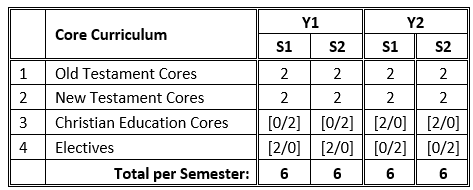
- SPECIALIST DIPLOMA IN THEOLOGICAL STUDIES (Dip.TS.)
Specialist Diploma in Theological Studies (Dip.BS.) is a specialised branch of training for lay-leaders in the knowledge of theology. The admission requirement is two ‘A’-level passes or its equivalent. Students are required to fulfil the track of training in Theological Studies (Systematic Theology and Pastoral Ministry). Total credits required for this programme is 24 credits. Students are required to sign up 6 credits / semester in order to complete this programme within a 2-year period. The academic load for each semester is as follows: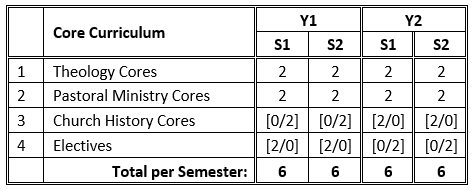
- DIPLOMA IN RELIGIOUS KNOWLEDGE (Dip.RK.)
The Diploma in Religious Knowledge (Dip.RK.) is a full-time programme to allow the students to immerse themselves in a theological training college and a deeper knowledge of theology and the Bible. The admission requirement is five ‘O’-level passes or its equivalent. Students are not required to follow a particular track of studies. They can sign up modules of their interest at their own time. However, the number of credits required must be fulfilled within a 5-year period. Other than the lectures, students will be assigned to a pastor/church each semester as part of the practicum training. Students will be exposed to the ministry of the church and will learn from the mentor, serving in the duties as assigned. Students will be assigned to different churches throughout their academic programme. Students are required to submit a final-year project in their last semester of studies. Total credits required for this programme is 24 credits. Students are required to sign up 16 credits / semester in order to complete this programme within a 2-year period.
Note: Credits for modules successfully completed in the Cert.BRK. / Cert.HRK. programme may be directly transferred into this programme.
- BACHELOR OF THEOLOGY (B.Th.)
The Bachelor of Theology (B.Th.) programme is designed to equip and prepare students for the full-time ministry. The admission requirement is two ‘A’-level passes or its equivalent. A broad-based curriculum is designed for this programme, encompassing the core modules of Biblical Studies (Old Testament and New Testament), Theological Studies (Systematic Theology and Pastoral Ministry), and the specialised core modules of Church History and Christian Education. Students are required to complete at least one module of the Biblical Languages (either Biblical Greek or Biblical Hebrew). On top of that, students will need to complete the Biblical Counselling modules partially. A thesis is required, together with the completion of the course on Theological Research & Writing as part of the requirement. Other than the lectures, students will be assigned to a pastor/church each semester as part of the practicum training. Students will be exposed to the ministry of the church and will learn from the mentor, serving in the duties as assigned. Students will be assigned to different churches throughout their academic programme. Total credits required for this programme is 96 credits. Students are required to sign up 16 credits / semester in order to complete this programme within a 3-year period. The academic load for each semester is as follows: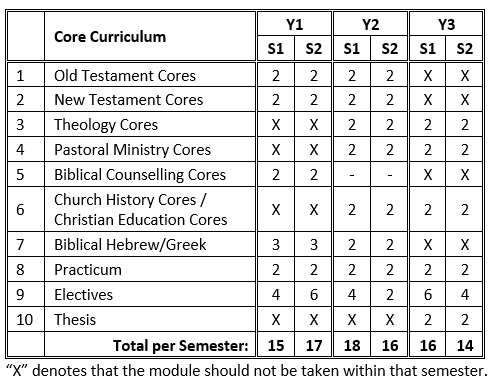
- MASTER OF DIVINITY (M.Div.)
The Master of Divinity (M.Div.) programme is designed to equip and prepare students for the pastoral ministry, limited to male applicants only. Applicants must demonstrate a calling to serve as a pastor. The admission requirement is a basic degree from a recognised university or a theological institution. A broad-based curriculum is designed for this programme, encompassing the core modules of Biblical Studies (Old Testament and New Testament), Theological Studies (Systematic Theology and Pastoral Ministry), and the specialised core modules of Church History and Christian Education. Students are required to complete both the Biblical Language modules (Biblical Greek and Biblical Hebrew). On top of that, students will need to complete the Biblical Counselling modules partially. A thesis is required, together with the completion of the course on Theological Research & Writing as part of the requirement. Other than the lectures, students will be assigned to a pastor/church each semester as part of the practicum training. Students will be exposed to the ministry of the church and will learn from the mentor, serving in the duties as assigned. Students will be assigned to different churches throughout their academic programme. Total credits required for this programme is 96 credits. Students are required to sign up 16 credits / semester in order to complete this programme within a 3-year period. The academic load for each semester is as follows: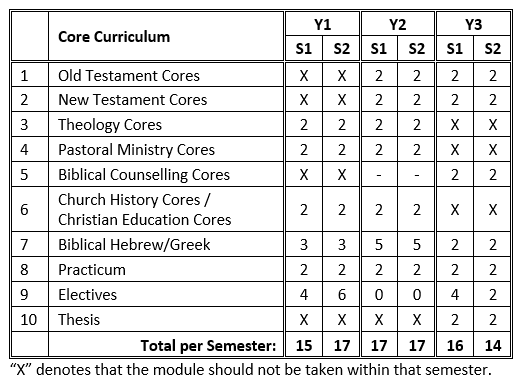
- MASTER OF BIBLICAL COUNSELLING (M.BC.)
The Master of Biblical Counselling (M.BC.) programme is designed to equip and prepare students for the counselling ministry. Applicants must demonstrate a calling to serve in the ministry. The admission requirement is a basic degree from a recognised university or a theological institution. A specialized curriculum is designed, encompassing the core modules of Biblical Counselling and Theological Studies (Systematic Theology and Pastoral Ministry). The study of biblical languages is not required. A thesis is required, together with the completion of the course on Theological Research & Writing as part of the requirement. Other than the lectures, students will be assigned to a pastor/church each semester as part of the practicum training. Students will be exposed to the ministry of the church and will learn from the mentor, serving in the duties as assigned. Students will be assigned to different churches throughout their academic programme. Total credits required for this programme is 64 credits. Students are required to sign up 16 credits / semester in order to complete this programme within a 2-year period. The academic load for each semester is as follows: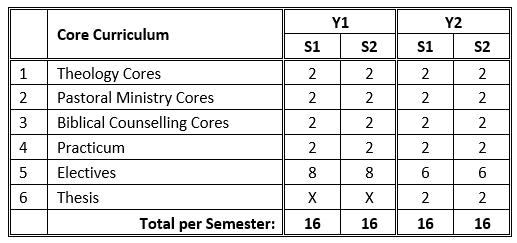
- MASTER OF BIBLICAL STUDIES (M.BS.)
The Master of Biblical Studies (M.BS.) programme is designed to equip and prepare students for the teaching ministry. Applicants must demonstrate a calling to serve in the ministry. The admission requirement is a basic degree from a recognised university or a theological institution. A specialized curriculum is designed, encompassing the core modules of the Biblical Studies (Old Testament and New Testament) and specialised modules of Christian Education. The students are required to complete at least one module of the Biblical Languages (either Biblical Greek or Biblical Hebrew). A thesis is required, together with the completion of the course on Theological Research & Writing as part of the requirement. Other than the lectures, students will be assigned to a pastor/church each semester as part of the practicum training. Students will be exposed to the ministry of the church and will learn from the mentor, serving in the duties as assigned. Students will be assigned to different churches throughout their academic programme. Total credits required for this programme is 64 credits. Students are required to sign up 16 credits / semester in order to complete this programme within a 2-year period. The academic load for each semester is as follows: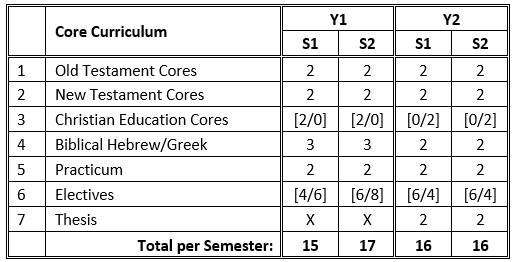
- MASTER OF THEOLOGICAL STUDIES (M.TS.)
The Master of Theological Studies (M.TS.) programme is designed to equip and prepare students for the Gospel ministry. The admission requirement is a basic degree from a recognised university or a theological institution. A specialized curriculum is designed, encompassing the core modules of the Theological Studies (Systematic Theology and Pastoral Ministry) and specialised modules of Church History. The students are required to complete at least one module of the Biblical Languages (either Biblical Greek or Biblical Hebrew). A thesis is required, together with the completion of the course on Theological Research & Writing as part of the requirement. Other than the lectures, students will be assigned to a pastor/church each semester as part of the practicum training. Students will be exposed to the ministry of the church and will learn from the mentor, serving in the duties as assigned. Students will be assigned to different churches throughout their academic programme. Total credits required for this programme is 64 credits. Students are required to sign up 16 credits / semester in order to complete this programme within a 2-year period. The academic load for each semester is as follows: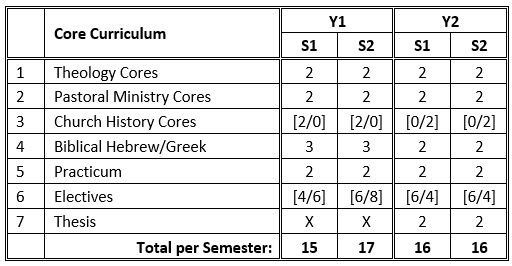
- MASTER OF MINISTRY (M.Min.)
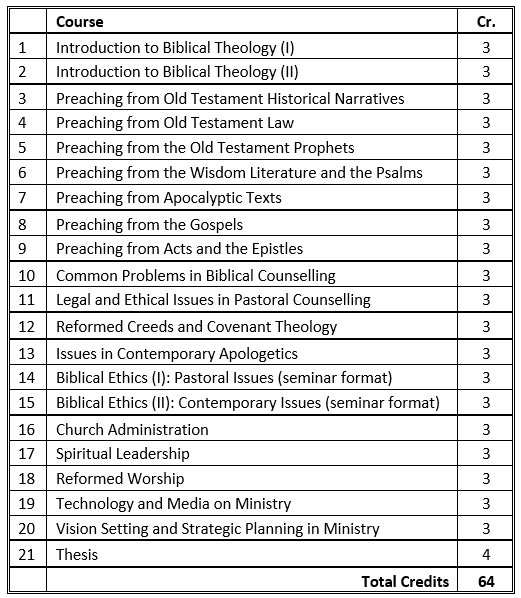
The Master of Ministry (M.Min.) programme is designed and intended for pastors/preachers/missionaries who are presently serving. Applicants must have been in active ministry for a minimum of five years. The objective is to help students enhance their ministry further. This is achieved by providing the students with a curriculum that would meet the theological and practical challenges of Christ-centred ministry. This programme offers courses that focus on biblical theology, expository preaching, biblical counselling in specific issues, church administration and pastoral formation. The curriculum is designed to be flexible, taking into consideration the fact that full-time ministers cannot be away from their ministry for extended periods of time.
The courses will involve pre-reading assigned material, followed by an intensive week-long modular session of lectures and end with papers to be submitted within a month of the end of a module. Four modules will be offered a year on: (i) the beginning of January (first/second week); (ii) the end of May (third/fourth week); (iii) the beginning of July (first/second week); and (iv) the end of November or beginning of December.
Applicants to the Master of Ministry (M.Min.) programme must meet the following requirements:
- Profession of faith in Christ;
- A basic degree with a cumulative undergraduate grade point average of at least 2.3 (on a 4.0 scale);
- Ministerial experience of at least five years (applicants without a basic degree may be considered if they have more than five years of ministerial experience);
- Proficiency in the English language; and
- Recommendations from a pastor and an elder of the church the applicant is presently serving.
FOUNDATION YEAR PROGRAMME
The Foundation Year Programme is not a stand-alone academic programme. Instead, it is coupled with our Bachelor / Masters programmes. The Foundation Year Programme is designed to help students to integrate into the main academic programmes, especially to the academic rigour required by the College, and the basic theology which forms the baseline of the foundation of the reformed faith.
The College reserves the right to offer provisional acceptance to applicants to the academic programmes they apply for, with the condition that they fulfil the requirement of the Foundation Year Programme.
The Foundation Year Programme runs for a year (over 2 semesters). If, at the end of the Foundation Year, the students are able to obtain a GPA of 2.00 and above (for the Foundation Year Bachelor Programme) or 2.33 and above (for the Foundation Year Masters Programme), they may be offered full-acceptance to their Bachelor / Masters programme. Students who are unable to fulfil this requirement would be deregistered or to be matriculated under a lower academic programme.
If the students do exceptionally well in the first semester of the Foundation Year Programme with a GPA of 3.67 (A-) and above, then they may be offered full-acceptance to their Bachelor / Masters programme at the end of first semester of the Foundation Year Programme.
The Foundation Year Programme is not applicable to the Diploma programme.
The curriculum of the Foundation Year Programme will be similar to the academic programme which the students are given the provisional acceptance. However, the Foundational Year students are allowed to sign up for a maximum 12 credits / semester. They are not allowed to sign up for any biblical language modules. Practicum is also required as part of this programme.
DISTANCE LEARNING PROGRAMME
The College is planning to set up a distance learning programme. We are in the process of establishing the infrastructure and administrative procedures to implement such a programme. The distance learning programme is only offered for certificate courses and to students who are not residing in Singapore; and on a case-by-case basis at the moment. For potential students who are keen in such a programme, please contact the office for more information.
ENGLISH LANGUAGE PROGRAMME
The medium of instruction in the College is English. It is important for all students to attain a certain level of competency in English in order to follow lectures, read theological books / journals and to be able to complete assignments of term / research papers. The basic requirement for English proficiency is as follow:
- A minimum grade of C6 for ‘O’-level English; or
- A minimum score of 60 for TOEFL iBT (internet-based test) or 500 for TOEFL PBT (paper-based test);
- A minimum score of 6.0 for IELTS; or
- A minimum score of 50 for PTE.
Note: Note the following acronyms used = TOEFL (Test of English as a Foreign Language), IELTS (International English Language Testing System) and PTE (The Pearson Test of English).
English Tests: If the applicant’s academic qualification was conducted in a college / university where the medium of instruction is not in English, a TOEFL / IELTS / PTE test is required. The test score must be submitted with the application. The test must be taken within 2 years of the date of application. Unless there is exceptional reason, the requirement of English proficiency is necessary for admission. If applicants are unable to fulfil the minimum English proficiency level required, they are advised to enrol themselves in English courses in their own country to improve their command of English; and then to retake the TOEFL / IELTS / PTE test to fulfil the score required before reapplying for admission.
English Proficiency Test (EPT): Upon admission, all international students will have to take an internal English Proficiency Test (EPT) which will be conducted by the College. The results of this test would not affect their admission. However, if the students are unable to pass the EPT, they would be required to attend an English-module and to sit for the EPT again at the end of the semester. If they are unable to pass the EPT after four attempts, they would be deregistered as students of the College. The College takes a serious view on the competency of English as part of the requirement for the academic programmes.